

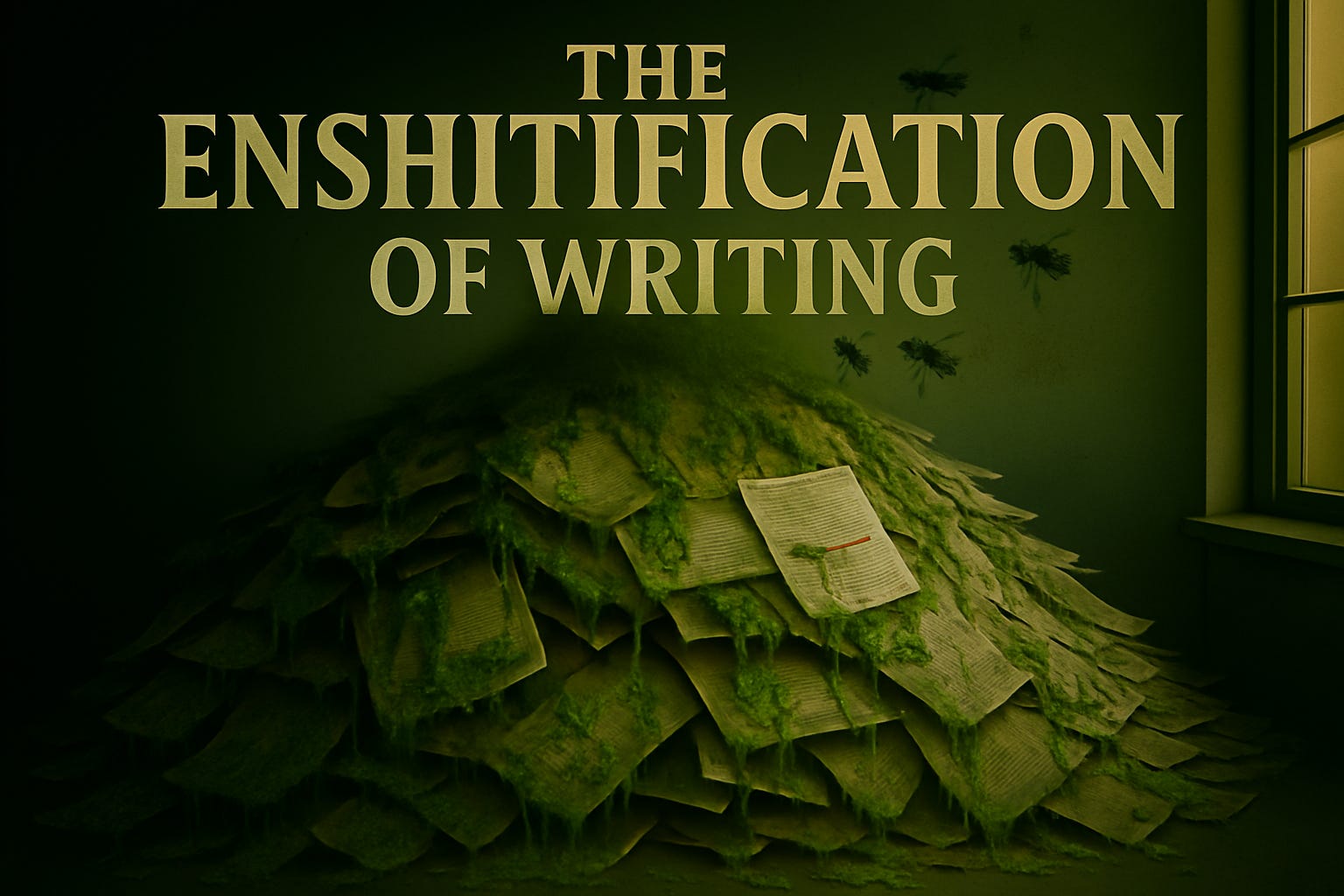
Something corrosive has spread through writing: the easy production of words without care. Call it the enshitification of writing. AI tools did not create this problem, but they made it cheap to scale the same shallow work that used to require human effort.
AI itself is not the enemy. Writing with AI is fine when used intelligently, with judgment, verification, and accountability. The real issue is misuse: handing the machine the pen and pretending supervision is optional. When people treat AI as a shortcut to replace reporting, sourcing, and thinking, what follows is churn that looks polished on the surface and brittle underneath.
You see the failure modes everywhere. Hallucinations, where models invent facts, quotes, or citations that do not exist. Plagiarism by remix, where outputs repurpose others’ structures or methods without clear attribution. Surface-level amplification, where content mills crank out thousands of barely varied posts that repeat the same ideas. These products crowd the web with material that reads like explanation but lacks experience.
Editors and researchers are documenting this pattern. Publishers that leaned too hard on AI have had to correct and retract pieces after readers caught errors and unattributed passages, which proves speed without oversight breaks credibility. In academia, AI-generated manuscripts have been flagged for reusing others’ methods without citation, raising hard questions about credit and novelty. SEO practitioners warn that obvious AI patterns…repetition, shallow coverage, awkward phrasing, and keyword stuffing…flood search results and push down genuinely original work. Detection and plagiarism tools help, but they are imperfect and reactive rather than preventive.
Tools like Grammarly and ProWritingAid are useful when they catch typos, tighten sentences, or flag unclear phrasing. Misused, they accelerate enshitification. Push every sentence through automated “clarity,” “engagement,” and “readability” sliders and you sand off voice, flatten rhythm, and convert lived language into corporate mush. Over‑reliance nudges writers toward safe synonyms, generic transitions, and passive constructions that score well in a dashboard but read like beige paste on the page. These apps are assistants, not auteurs…great for mechanical cleanup, terrible as final editors of style, argument, or truth.
Autocrit takes the same problem and dials it up. Its reports tempt writers to chase “ideal” averages for pacing, repetition, and sentence mix until a living draft is hammered into template compliance. The result often reads like it was written to satisfy a spreadsheet: technically tidy, emotionally vacant, and indistinguishable from a thousand other drafts that hit the same metrics. Used sparingly, these tools can highlight issues worth a human decision; used as the decider, they train writers out of voice and readers out of patience.
This matters because writing is how we share knowledge and make arguments. When content becomes churn, readers lose confidence. Brands that publish sloppy material sacrifice reputation. Research polluted by automated outputs steals attention and credit from the humans who did the labor of discovery.
The remedy is practical and editorial. Keep humans central. Use AI for tasks it performs well, like brainstorming, outlining, or formatting, and never as a substitute for reporting, verification, or judgment. Require transparent attribution when AI plays a substantive role and document the verification steps taken. Train editors to spot AI fingerprints: repetitive phrasing, odd transitions, and unverifiable sources. Invest in fact-checking and source verification instead of chasing output quotas.
For academic work, peer review and novelty checks must adapt. Any AI-assisted manuscript should include provenance for ideas and explicit citations that can be verified. If methods overlap with prior work, reviewers should demand clear acknowledgment and treat uncredited idea reuse as a serious integrity issue.
Publishers and platforms should stop rewarding churn. If ad revenue and SEO tactics fund low-value content, the incentive to produce it stays in place. Cut the reward by prioritizing original reporting and verifiable data, require named authorship, and favor work that includes firsthand examples, interviews, or proprietary analysis.
Writers must use AI as a tool, not an author. Add first-hand reporting, original examples, a distinct voice, and take responsibility for every claim you publish. If your name is on a piece, own the facts and the argument personally.
The bill for sloppy automation is paid in trust and time. Below is an anonymized case study showing how a mid-size company’s choice to prioritize speed over verification cascaded into measurable damage — the kind of slow leak most teams dismiss until the metrics force a reckoning.
Case study: a quiet retraction and its cost
Case study (anonymized, drawn from public cases)
A mid‑size digital publisher launched an aggressive content program: long-form, “research‑backed” posts twice a week to drive SEO and demos. The team was lean — one editor, two writers, and a marketing lead — and deadlines were tight. To hit the quota they leaned on large‑language models to generate outlines and first drafts, routed everything through grammar-and-style dashboards, and used an automated editing scorecard as the final gate. At first the output looked successful: traffic rose and editorial calendars stayed full. Then a reader tried to verify a handful of precise citations in a flagship post and discovered the DOIs didn’t resolve and the cited journal issues didn’t exist. What began as a comment thread became a small scandal.
The publisher made a quiet correction, removing the bogus citations and editing the copy without an editor’s note. That choice cost them more than they expected. Conversion signals tied to the campaign dropped and inquiries about the publisher’s reliability spiked on social channels and in support queues. Internally, the editor and writers spent days re‑checking sources and patching links — time that erased any short‑term savings from automating verification. The reputational hit was not a headline-grabbing scandal; it was a slow leak: partners and prospects circulated the discovery in private messages, and the publisher’s lead gen funnel stiffened until trust was rebuilt.
This pattern matches documented problems elsewhere. Predatory and low‑quality journals have published AI‑generated or misattributed articles that contained fabricated references and DOI claims, forcing researchers and editors to police and retract content (see the GIJIR investigation and analysis) [https://researchintegrityjournal.biomedcentral.com/articles/10.1186/s41073-025-00165-z]. Journals have also retracted batches of commentary and short pieces after discovering undisclosed LLM use at scale, underscoring how easy it is for automated text to propagate without adequate human accountability [https://retractionwatch.com/2025/02/10/as-springer-nature-journal-clears-ai-papers-one-universitys-retractions-rise-drastically/]. Even preprints written with chatbots have resurfaced with made‑up references, prompting withdrawals and public alarm [https://retractionwatch.com/2023/09/01/withdrawn-ai-written-preprint-on-millipedes-resurfaces-causing-alarm/]. The broader context is a rise in retractions and integrity failures tied to automation and low editorial vigilance [https://www.nature.com/articles/d41586-023-03974-8].
Three practical fixes stopped the leak in the anonymized publisher’s case and are visible in better‑run examples across the field. First, require a verifiable primary source for every specific statistic or named study and log a timestamped verification step in the CMS before publishing. Second, cut output targets so editors have time to do the work that automation cannot: calling sources, reading original papers, and confirming quotes. Third, publish transparent correction notices for substantive edits; quiet fixes look like coverups and widen the trust gap. Those changes cost cadence in the short term but returned stability and recovered audience confidence within weeks.
There is a clear lesson here: treating writing as a metric to be optimized will buy volume but not trust. The inverse is also true. Paying the small upfront cost of verification preserves both reputation and long‑term funnel performance.
This article was written collaboratively using Abacus.AI’s ChatLLM Teams. That collaboration differs from the abuses described in this piece because humans retained editorial control: prompts, fact‑checking, sourcing, and final voice decisions were made or approved by the author, with the tool serving only as an assistant.
The real crisis is the disappearance of sweat, doubt, and lived experience from the page. Machines can string words together, but they can’t shape meaning from memory. The fix, as you say, is simple but increasingly rare - care enough to think, verify, and bleed a little into every paragraph.