

Nine out of ten enterprise AI agent pilots never reach production. That number comes from Deloitte’s 2026 research, and companies that did deploy have started pulling their agents back out.
Every explanation blames the model. Not enough context, bad prompting, wrong framework, wait for the next release. I think the real cause is older and simpler. Nobody decided, before the build, what the thing was supposed to do when it was on its own.
Autonomy is not a feature you buy
A system is autonomous when somebody has written down what it may decide alone, what it must wait for, and what it does when waiting is not an option. A capable system with no such document is not autonomous. It is unsupervised.
The industry has spent three years on capability and almost none on permission.
A water system that ran alone for entire winters
In the 1980s I led a project for a water district in New Haven, Connecticut. Several thousand remote devices across the region. Sensors reading levels and flows, mechanisms that opened gates and dams and drained tanks, all reporting to a central server where operations staff made the calls.
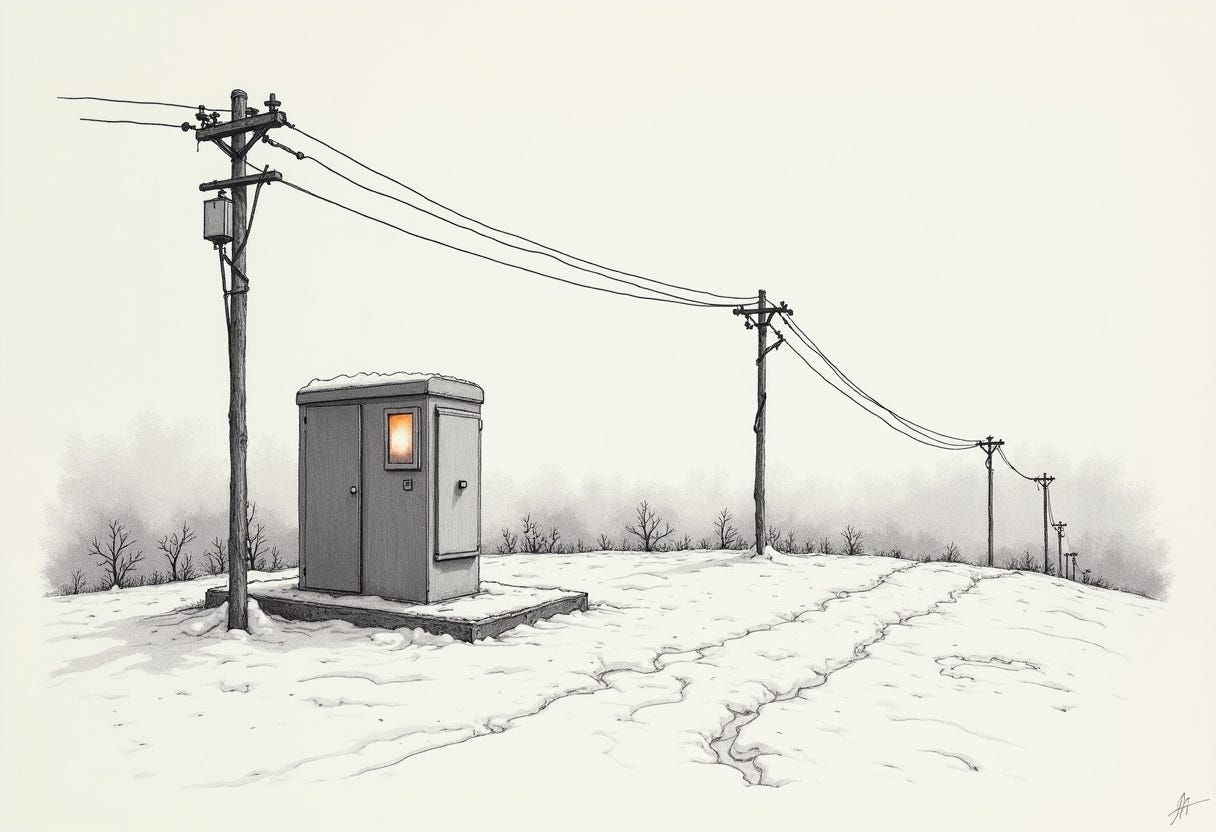
New Haven gets a lot of snow. Communications ran over phone lines, because that was the entire list of options, and everyone understood those lines would go down in winter. Not might. Would.
And the water still had to flow. So we had a system that would routinely lose contact with every human responsible for it, for weeks and sometimes months, and could not stop working during that time.
The answer was to give every remote station a profile of its own behavior, built from the previous few years of water flows and weather at that specific location. When the line dropped, the station stopped waiting and started deciding from that picture. What to let flow, what to hold, what to open.
No model. No training run. No learning of any kind. A profile, a set of parameters, and a decision table.
The system was not intelligent by any standard. It was still autonomous, because somebody decided in advance what it could do alone.
The boundary, decided before any code
Under normal conditions the operations staff decided. The stations decided only when the staff could not be reached, and what they could decide was bounded by the profile, which meant they could act inside the range of normal and could not invent anything new.
The station was not trusted to be clever. It was trusted to keep doing the ordinary thing while nobody was available to ask for something unusual.
Compare that with an agent handed broad system access, a general-purpose model, and no written boundary. That agent is being trusted to be clever. Some night it will be clever about the wrong thing with nobody there.
The question worth asking this week
Ask what your agent does when a service it depends on is unavailable. Most of the time nobody knows.
The agent calls a service. The service was there in testing and in the demo, so everybody moved on. Then one day it is not there, and the agent retries, retries differently, produces a confident answer built on nothing, or loops until somebody notices the cost.
The New Haven design started from that condition rather than discovering it in production. We built the failure mode first and the normal mode second. I have not seen an AI project do that.
One page beats a governance platform
A large enterprise has a governance function and a committee. A company with forty people has neither, and gets told constantly to move fast and sort it out later.
The smaller company has one advantage. One person can keep the entire picture in their head, so the decision about what an agent may do alone can be made by somebody who understands the business, in an afternoon, on a single page.
That page is worth more than any governance platform on the market. Almost nobody writes it, because writing down limits feels like slowing down.
The companies that skip the page are the ones filling out the ninety percent.
The full article is on my site: https://thewritingking.com/autonomy-is-a-design-decision/. It runs longer, carries the diagrams, and answers the questions readers ask most.
These are AI-made summaries of longer articles on my site, written with AI assistance from my own interviews and my own career. Nothing goes out that I have not read and approved.