

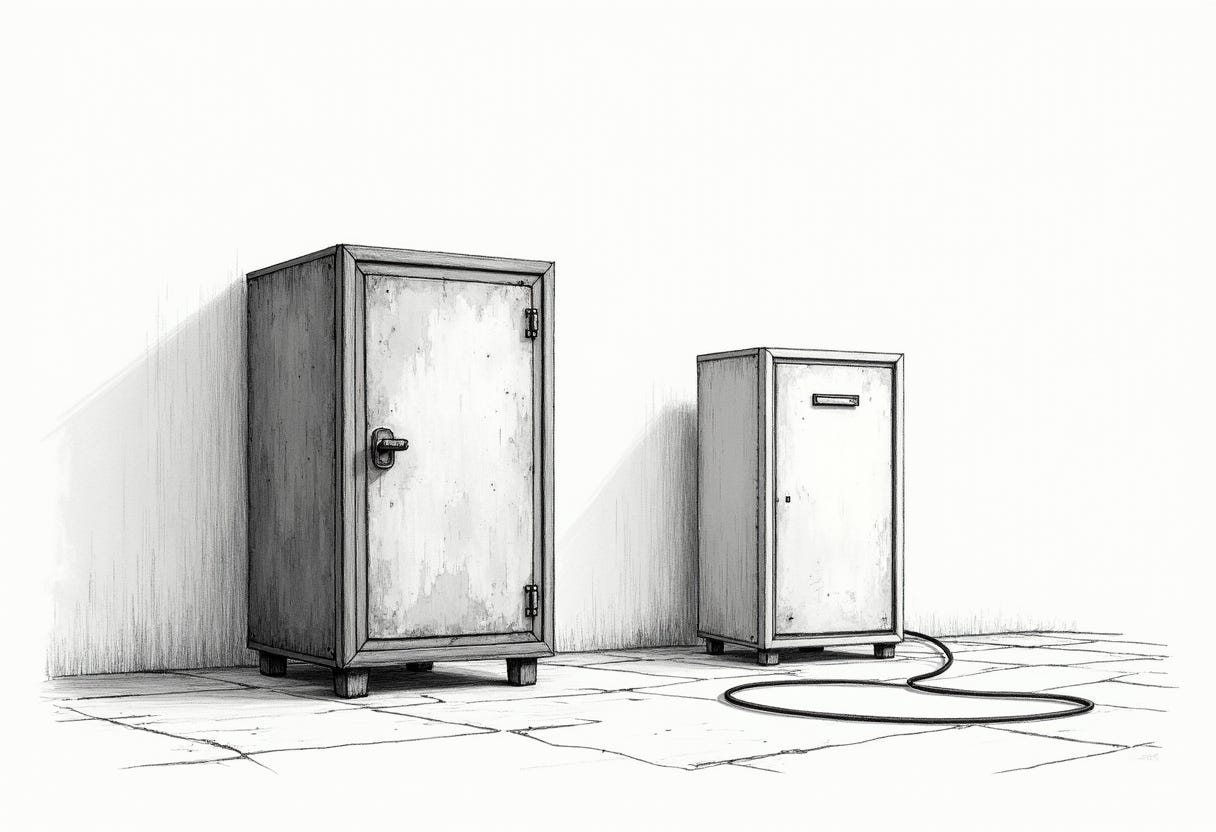
A hard constraint will hand you a solution you would never have picked from a list of options, and the solution is often better than what you would have chosen freely.
Free choice produces the obvious answer
Give a group unlimited time and budget and they will schedule the outage, move the systems, do the work, and move them back. That is a fine plan and it requires no thought.
Remove the outage from the table and something different happens. The obvious answer is gone, so the team has to look at the actual problem rather than at the standard procedure for problems of that shape.
Most good engineering I have watched came out of somebody being told they could not do the normal thing.
A tile that was buckling
The consultant running our computer room came to me one day. A raised floor tile under the main cabinet was buckling. Not cracked, not worn. Buckling, which meant it could give way at any moment.
Above that tile sat the cabinet holding eight machines running the business.
This had to be fixed immediately, so we took the next weekend. A week to plan, a weekend to execute.
Both answers disappeared
Move the workloads elsewhere, take the cabinet down, replace the tile, bring it back. That is what anyone would propose and it is what I would have proposed.
We did not have the spare capacity to relocate eight machines. We moved a few and could not move the rest.
Then my boss added the constraint that settled everything. Zero downtime. The business would not stop for this.
Now the standard answer was unavailable, and so was the fallback. What remained was one option nobody would pick from a menu.
Lift the cabinet while it was live and running. Replace the tile underneath it. Set it back down.
A bladder, bracing, and a clipboard
I walked into the computer room and there was an enormous inflatable bladder under the cabinet, with bracing everywhere.
It looked like a nightmare. It was also clearly not going to fall over, which is the impression good rigging gives you.
They lifted it. They replaced the tile. They set it back down. It went very well, and it was expensive.
Nothing about the operation was improvised. The firm was US Technical Services, and the people doing the work were ex-Marines and ex-special forces. They had clipboards. They had a written plan and they followed it exactly.
A dangerous operation was boring to watch, which is what competence looks like from the outside.
Procedure beats skill under pressure
The people lifting that cabinet were highly capable, and that is not why it worked. It worked because somebody had written down the sequence, everyone knew their part, and nobody had to make a judgment call while several tons of equipment sat on an air bladder.
The failure mode in this kind of work is never the risky operation. It is the risky operation performed by people improvising, where two competent people each make a reasonable decision that contradicts the other.
Most companies have never written down what happens during their equivalent moment. They find out how well they improvise while the thing is already buckling.
The three or four pages worth writing
Not a binder. A page each for the things that would hurt. Restoring from backup. Failing over to a second site. Bringing the business up after an extended outage. Handling the discovery that something physical is about to fail.
Each page says who does what, in what order, and who decides. Writing one takes an afternoon.
The value is not the paper. The value is that writing it forces the decisions in advance, when there is time to think.
Keeping my boss out of the room
He wanted to watch the lift. I told him no.
He asked why, and I told him the truth, which was that watching it would probably upset him. He accepted that and stayed out of the computer room.
I did not hide the operation. He knew what we were doing, he had set the constraint that shaped it, and he had approved the cost. What I declined was the viewing.
There is a version of managing upward that means controlling what the person above you knows, and that version ends badly. This was different, and he trusted the judgment.
The full article is on my site: https://thewritingking.com/constraints-produce-solutions/. It runs longer, carries the diagrams, and answers the questions readers ask most.
These are AI-made summaries of longer articles on my site, written with AI assistance from my own interviews and my own career. Nothing goes out that I have not read and approved.