

Your dialogue sounds like a police report. Clean sentences. Direct answers. Every question addressed in order.
Real people don’t talk like that.
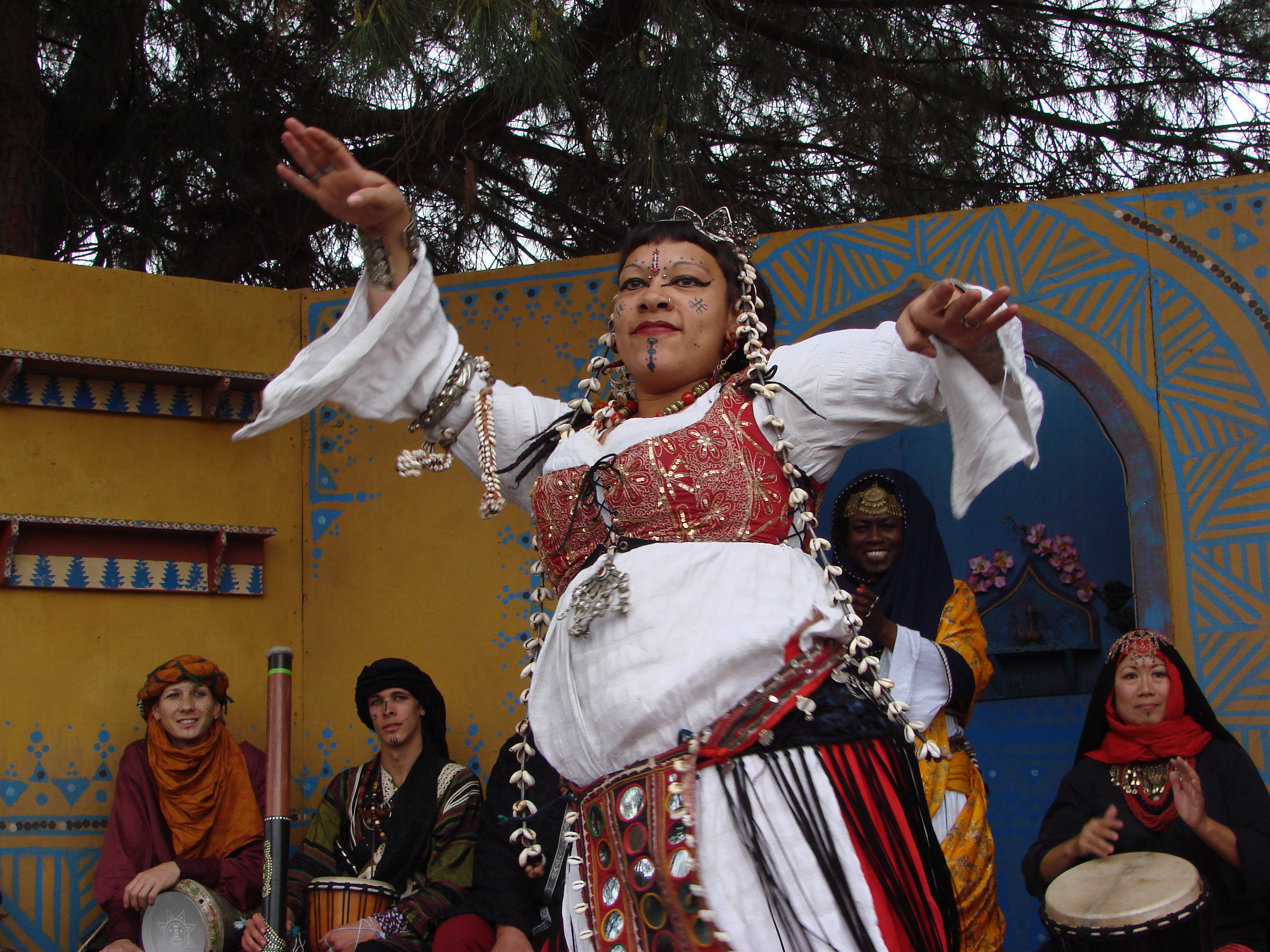
The person who taught me this wasn’t a writing instructor. She was a belly dancer named Marjhani, and she never read a word I wrote.
The Belly Dance Photographer
The thermometer had crept past a hundred degrees by midday at the Renaissance Faire. I had claimed a spot in the back row of the belly dance stage, on straw bales arranged in half-circles facing the performance area. A massive oak overhung where I sat, and I leaned into its shade with something close to gratitude.
I chose the back row for practical reasons. I could shoot over the heads of everyone in front of me. But that wasn’t the only reason. I was still caved in from grief, still moving through the world trying not to be noticed. The back row let me observe without participating. I could hide behind my camera and pretend I was just a spectator passing through.
When the show ended, I sat for a moment longer, letting the heat wash back over me. That was when I noticed a short, dark-skinned woman walking directly toward me.
Marjhani scared the crap out of me.
She was forceful and didn’t hesitate to loudly make her opinion known. She occupied space unapologetically. She was everything I was not.
She walked right up and introduced herself. Told me she and her dancers enjoyed the pictures I took. I’d been uploading photos to a website, letting people use them without charge. The dancers had found them.
Then she said something that changed everything.
I was now officially part of the troupe. Their photographer. Before I could protest or retreat to the safety of my back-row anonymity, she put her arms around me and gave me a big hug.
For months I had been drifting through life like a ghost. Physical contact had become rare. Warmth had become rare. And here was this stranger, this force of nature, pulling me into an embrace like I was family.
She dragged me to the front of the stage and introduced me to the other dancers. Every single one gave me a hug. The women. The men. All of them welcomed me like I belonged there.
One more thing. I was no longer allowed to sit in the back row. From now on, she expected to see me front row center. She would reserve my spot by writing my name on a piece of paper and pinning it to a straw bale.
That paper flag marked my place in a community I hadn’t known I needed.
(The full story: https://masterofworlds.com/chapter/day-everything-changed/)
Four hundred thousand photos over eight years. Renaissance faires, studio sessions, performances at restaurants and festivals and private parties.
I shot so many images that photography stopped being a hobby and started being a discipline. And that discipline taught me more about writing than any craft book I’d read.
What a Camera Can’t Do
A camera can’t record thoughts.
I couldn’t photograph “she felt nervous before going onstage.” I could only catch the way her fingers twisted the fabric of her hip scarf. The quick glance toward the exit. The breath she held just before the music started.
Nine hundred eighty thousand images later, I’d trained myself to see external signals of internal states. The tells. The body language. The moment before the mask goes on.
Photography forces pure showing. No narration. No internal monologue. Just what the eye can capture.
That transfers directly to prose.
Writers get lazy with interiority. “She felt sad.” “He was angry.” “They were nervous.” The camera taught me to delete those sentences and ask: what does sad look like from the outside? What does angry do with its hands? Where does nervous put its eyes?
A dancer preparing to perform doesn’t think “I’m anxious.” She checks her costume three times. Adjusts a hairpin that doesn’t need adjusting. Laughs a little too loud at someone’s joke.
I learned to watch hands, not faces. Faces lie. Hands tell the truth. The way someone grips a coffee cup. The finger tapping against a thigh. The sudden stillness when a name gets mentioned.
Eight years of shooting performers taught me that the real story lives in the moments between poses.
Why Your Dialogue Sounds Like a Police Report
Here’s what most dialogue looks like in amateur manuscripts:
“Did you take the money?”
“Yes, I took the money. I needed it for my mother’s surgery. She’s been sick for three months and the insurance won’t cover the procedure.”
Clean. Complete. Responsive. Every question answered directly, every sentence finished, all relevant information delivered efficiently.
Also completely fake.
Real people don’t talk like that. They interrupt. They deflect. They answer questions nobody asked while dodging the ones on the table. They trail off mid-sentence when something hurts too much to finish.
“Did you take the money?”
“My mother, she’s...” A hand moves to the throat. “The insurance, you know how they are. Three months watching her just... and they send these letters, these goddamn letters that say...”
“The money. Did you take it?”
“What would you have done?”
The second version tells you everything the first one does, but through behavior instead of exposition. The hand at the throat. The unfinished sentences. The deflection into a counter-question.
The AI-Enhanced Dialogue Handbook calls this subtext: what characters communicate through everything except their actual words. Speech patterns, interruptions, the things they won’t say.
I ghostwrite memoirs now, and I see the same principle in interviews. Last week a client told me about her father’s death. She didn’t say “I was devastated.” She said “I kept his coffee mug in the cabinet for three years. Couldn’t throw it out. Every morning I’d see it and think, I should deal with that. And then I’d close the cabinet.”
That’s showing. That’s what people do with grief. The mug says more than “I was devastated” ever could.
The camera taught me to see those moments. The performer who won’t look directly at her partner during a duet. The quick adjustment of a smile that slipped. The shoulder that tightens when a certain song starts. The cabinet that stays closed.
Writing dialogue means capturing what people do while they’re talking, not just what they say.
The Discipline That Transfers
I still shoot sometimes. Not as much as I used to. But the training stays.
When I write, I see the scene through a viewfinder. What would the camera catch? What would stay invisible? If I can’t photograph it, I probably shouldn’t be telling readers about it directly.
The AI-Enhanced Showing and Telling Handbook breaks this down systematically. When to stay external, when interiority earns its place, how to balance the two. But the core insight came from a dusty ren faire and a woman named Marjani who decided I belonged in the front row whether I liked it or not.
Your dialogue sounds like a police report because you’re transcribing instead of capturing.
Stop writing what people say. Start writing what they do.
The AI-Enhanced Dialogue Handbook — 276 pages on creating voices readers can distinguish without tags. https://masterofworlds.com/story/dialogue-handbook/
The AI-Enhanced Showing and Telling Handbook — When to stay external, when interiority earns its place. https://masterofworlds.com/story/showing-and-telling-handbook/
Ghostwriting inquiries: thewritingking.com