

Every transformation vendor sells alignment, and alignment is not for sale.
The failure nobody sells a product for
Before anything can be built, a large number of people have to agree on what gets built, and they will not.
Every vendor in this market sells a framework that promises alignment. Workshops, discovery phases, stakeholder maps. Those produce documents. What they do not produce is agreement, because the disagreement is real and no process dissolves it.
A pallet of paper a day
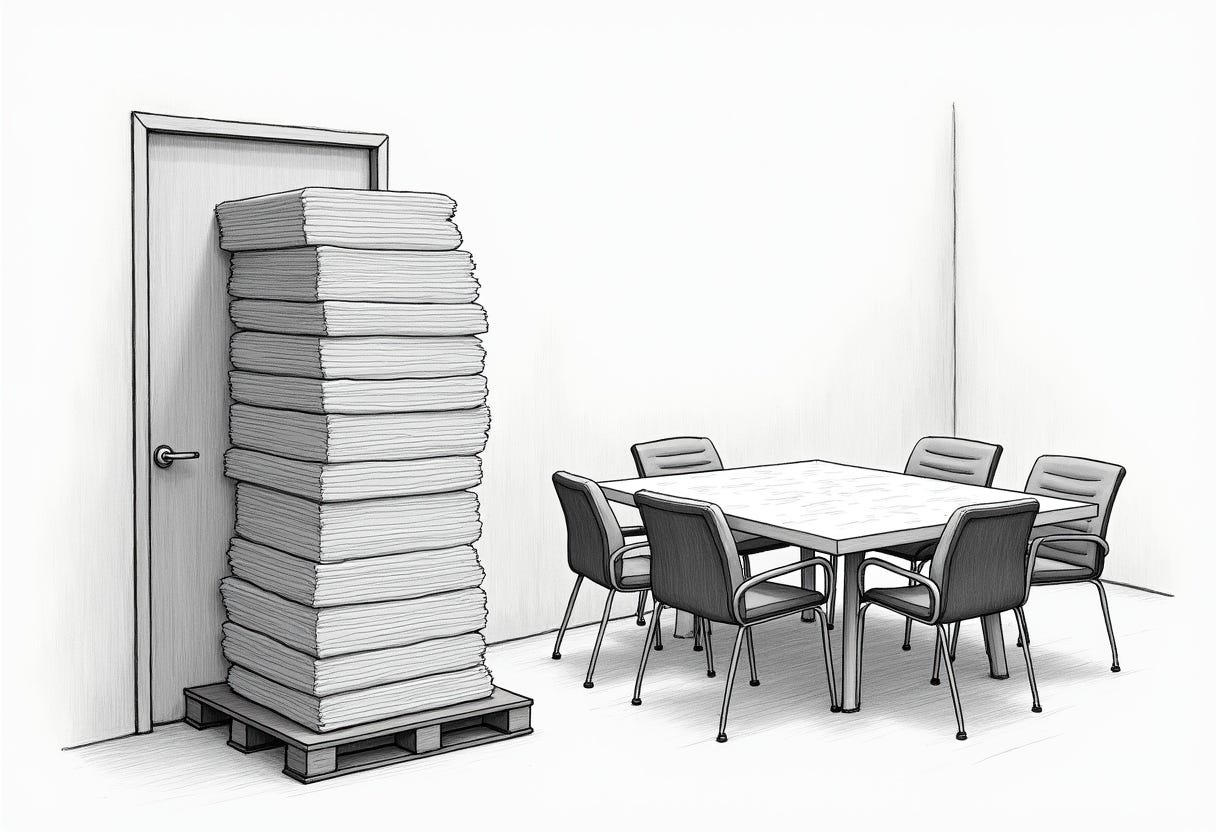
When I arrived at a major national retailer in the mid-1990s, the company ran on paper. Paper in the accounting room. Paper manifests at the warehouses. Accounting, human resources, everything, done by hand.
The printers produced hundreds of reams a day. My recollection is a pallet of paper, every single day, and I do not think that is an exaggeration.
The accounting equipment was a set of old machines I only saw a couple of times. Strange devices that reminded me of an abacus.
My job was to put my arms around the project and manage the pieces, alongside the development person, the store person, and the network person. Nobody called it a digital transformation, because the phrase did not exist yet.
Everyone was reasonable and nobody agreed
Hundreds of people across departments that had never needed to agree on anything suddenly had to agree on how the company would work. Accounting wanted one thing. The warehouses wanted another. The stores wanted a third. Every one of those positions was reasonable from where the person stood.
They were not being difficult. Each department had built its process around what paper allowed, and each had legitimate reasons for its own way of working.
What I learned is that unanimous agreement is not available at that scale. You reach a consensus quickly and then you decide. Sometimes you override people and sometimes you go along with them, and usually it is a bit of both.
Set a date and say it out loud
The date is what makes the rest work. A discussion with no end runs until somebody with authority loses patience, and the decision that comes out of that is worse and lands harder, because it arrives as an interruption rather than as a scheduled event.
Announce the date at the beginning. Say plainly that every department will be heard, that not every department will get what it asked for, and that the decision happens on that day.
Then hear people properly. Being overridden after a real hearing is survivable. Being overridden by somebody who never listened is what produces the quiet non-cooperation that sinks the rollout six months later.
Overriding the department that optimizes for itself
Whoever is protecting their own department at the expense of the whole.
That is easy to write and hard to identify, because nobody experiences themselves that way. The warehouse manager arguing for warehouse requirements is doing his job.
The test is whether the request survives the question of what it costs everyone else. Ask it out loud, in the room, and let the person answer. Some requests survive and get adopted. Most get modified. A few do not, and the person on the receiving end has at least seen why.
The cost in trust is real
Every override spends a little of the relationship with the person overridden. Enough of them, made carelessly, and a project acquires people who will not sabotage it and will not help it either.
A small company feels this more sharply. At forty people there is no distance to absorb it. Everyone knows who got overruled, and the person who lost the argument is sitting across the table at lunch.
Explain the reasoning privately and specifically rather than announcing the outcome to a group. And give ground where the cost to the whole is low, since a leader who has never conceded anything is not making decisions, they are issuing them.
Strip away thirty years of vocabulary and a transformation is a coordination problem wearing a technology costume. The technology part is the part you can buy.
The full article is on my site: https://thewritingking.com/consensus-you-cannot-get/. It runs longer, carries the diagrams, and answers the questions readers ask most.
These are AI-made summaries of longer articles on my site, written with AI assistance from my own interviews and my own career. Nothing goes out that I have not read and approved.